
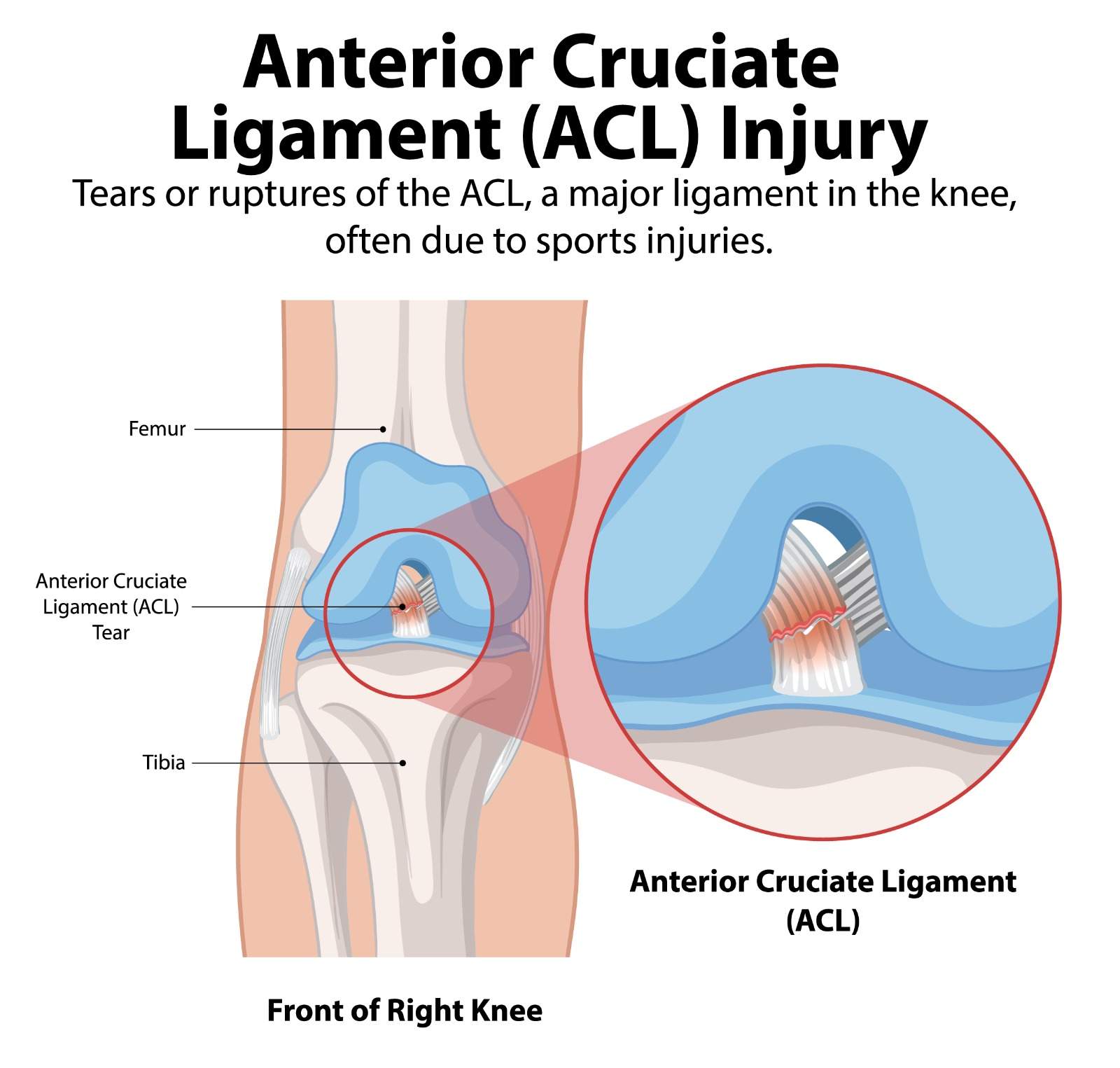
The anterior cruciate ligament is a small band of tissue inside the knee, and its job is to keep the joint stable during turning and pivoting. Once it is torn, the knee is often described by patients as unreliable. ACL reconstruction surgery is the procedure by which this ligament is rebuilt, though not every torn ligament requires an operation.
How an ACL Tear Usually Happens
Contact is not always involved, since a sudden change of direction while running, an awkward landing after a jump, or a twist of the knee with the foot planted on the ground is enough to cause the damage. A popping sound is reported by many patients at the moment of injury, and swelling develops within a few hours.
Symptoms by Which a Torn Ligament Is Suspected
Diagnosis is not made on pain alone, and the following complaints are looked for:
- Swelling of the knee within the first twenty-four hours
- A feeling of the knee giving way while walking on uneven ground
- Difficulty in fully straightening the leg
- Pain along the joint line, which may indicate an associated meniscus tear
Torn ACL treatment is planned only after these findings are confirmed by an MRI scan.
When ACL Tear Surgery Is Actually Required
Not all patients are advised an operation. A sedentary person with a partial tear may do well with physiotherapy and a brace. ACL tear surgery is recommended when instability continues in daily life, when the patient is young and active, when sports participation is intended, or when other structures inside the knee have also been damaged.
What Is Done During ACL Ligament Surgery
The torn ligament cannot be stitched back in most cases, and therefore a graft is used in its place. Tissue is taken either from the hamstring tendons or from the patellar tendon of the same patient, and in selected cases a donor graft is considered. The knee ligament reconstruction is carried out through arthroscopy, with two or three small openings rather than a long cut.
Timing of the Operation and Why It Matters
Immediate surgery is generally avoided because swelling and stiffness are first brought under control through a few weeks of physiotherapy, since a stiff knee operated upon too early tends to remain stiff afterward. ACL reconstruction is therefore usually planned three to six weeks after the injury, though a delay of some months does not spoil the result.
Recovery After Knee Ligament Reconstruction
The graft takes time to become a living ligament, and this is the reason rehabilitation is spread over months:
- The first two weeks, when swelling is controlled and the knee is straightened fully
- Weeks two to six, during which walking without support is regained
- Six weeks to three months, when strengthening of the thigh muscles is emphasized
- Three to six months, by which time jogging in a straight line is allowed
- Nine months onwards for pivoting sports
Returning to the field before this period is over remains a common reason for repeat injury after ACL reconstruction.
Risks That Are Explained Before Consent
Complications are uncommon, though they are never hidden from the patient.
- Stiffness of the joint
- Pain at the site from which the graft was harvested
- Infection, which is rare after arthroscopy
- Failure or stretching of the graft itself
Careful technique and supervised rehabilitation keep these figures low.
ACL Reconstruction Surgery - The Result That Can Be Expected
Stability of the knee is restored in the large majority of cases, and return to the previous level of activity is achieved by most patients who complete rehabilitation. ACL ligament surgery is not a guarantee against future injury, yet the risk of the knee giving way during ordinary movement is very largely removed.
An experienced surgeon offering ACL reconstruction surgery in Kolkata, like Dr Saem Ishtiaque, will assess whether the graft is required at all.
Do Not Ignore a Knee That Keeps Giving Way
An untreated tear does not remain a single problem, since repeated episodes of instability damage the cartilage and the meniscus over the years. Torn ACL treatment taken up at the right time protects the rest of the joint, and that decides how the knee behaves twenty years later.